
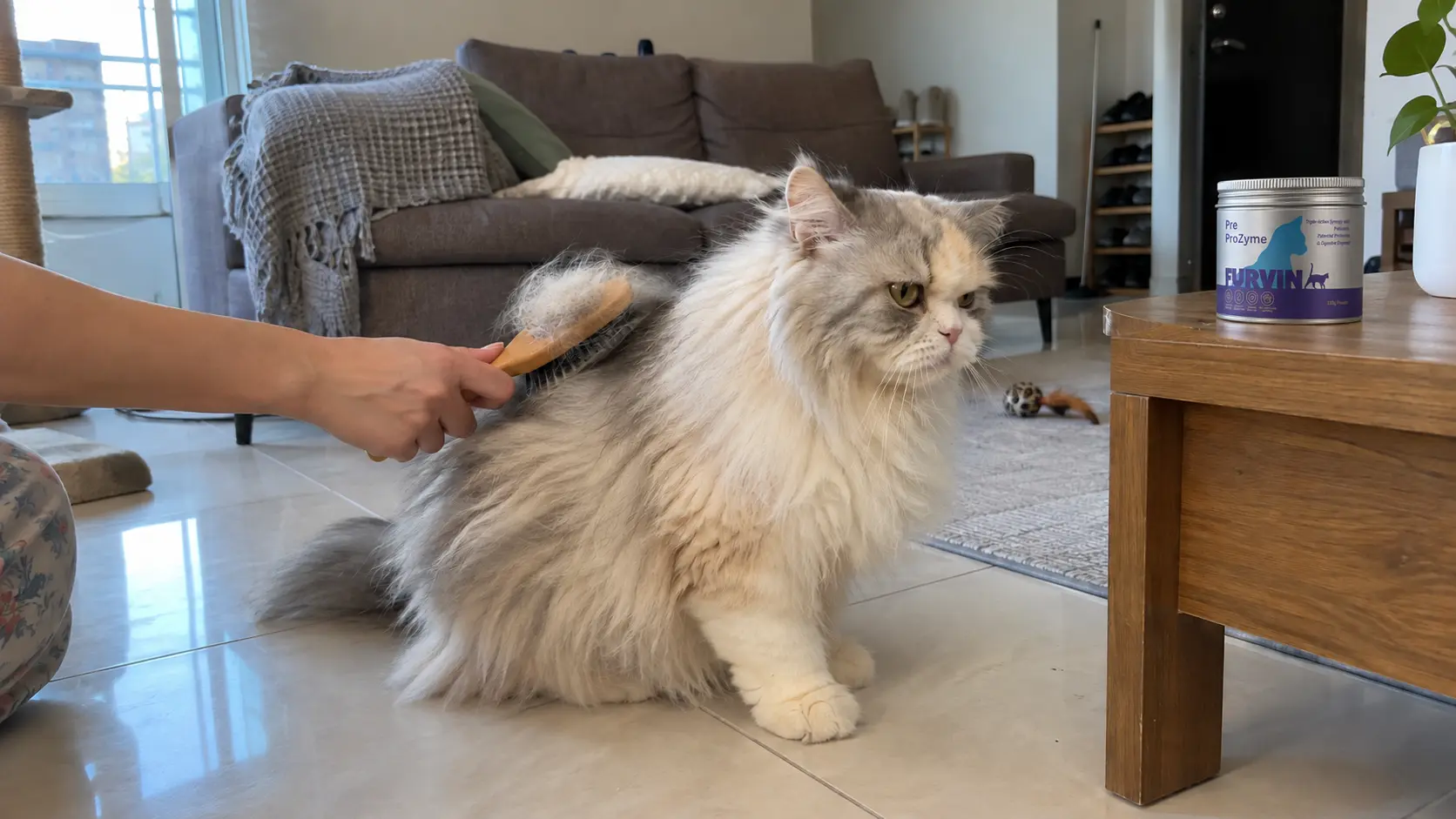
Hairballs begin on the coat, but they become a digestive event once fur is swallowed.
Most swallowed hair should travel through the gut and leave in the stool.[1] A useful routine therefore works from both directions:
The 30-Second Answer
Your cat's tongue collects loose fur during grooming. Because hair is largely keratin, it is not simply digested away. Most should move onward into the intestine; some can remain in the stomach, clump together and come back up as a hairball.[1]
Hairballs may appear more often when there is:
- heavier shedding or a long, dense coat
- extra grooming caused by irritation, stress or discomfort
- more swallowed hair than usual
- less-efficient movement through the digestive tract
How Does a Hairball Form?
Loose fur → grooming → swallowing → stomach → stool or hairball
A cat's tongue has backward-facing papillae that pull loose hair towards the throat. Once swallowed, that hair has two main outcomes: it moves through the intestine and leaves in faeces, or it collects in the stomach and is eventually vomited.[1]
The practical goal is not to “dissolve” every strand. It is to reduce unnecessary hair intake and support normal digestive passage.
Why does it look like a tube?
A vomited hairball is often cylindrical rather than round because it is compressed while passing through the oesophagus.[1]
Why Does It Keep Happening?
- More loose fur: Heavy shedding creates more material for the tongue to collect.
- Long or dense coats: Cats such as Persians and Maine Coons may swallow a larger volume during grooming.[1]
- Extra grooming: Fleas, irritated skin, allergy, pain or stress can increase licking. Bald spots, redness or repeated licking of one area deserve attention.
- Digestive passage: Diet composition, fibre type, hydration, motility and individual health influence what happens after fur is swallowed.
A controlled study in 21 adult cats found that selected higher-fibre diets increased faecal hair excretion in the long-haired group over 14 days, although the same effect was not shown in short-haired cats.[2]
That does not mean every fibre or every dose works identically. It does show why hairball care should not stop at the brush.
Hairball, Vomiting or Coughing?
- Hairball: Retching followed by a damp, cylindrical clump with obvious hair.
- Vomiting: Food, foam, fluid or bile comes up, with little or no compacted fur.
- Coughing: Repeated hacking or neck extension without producing a hairball. Feline asthma and other respiratory problems can look similar.[1]
If you are unsure, record a short video for your veterinarian. A few seconds of the episode can be more useful than describing the sound later.
When Hairballs Become Dangerous: Two Real Cases
Most hairballs do not become obstructions. These real cases show the pattern that should change a cat parent's response from “monitor at home” to “contact a veterinarian.”
Case A: A fist-sized hairball visible on X-ray
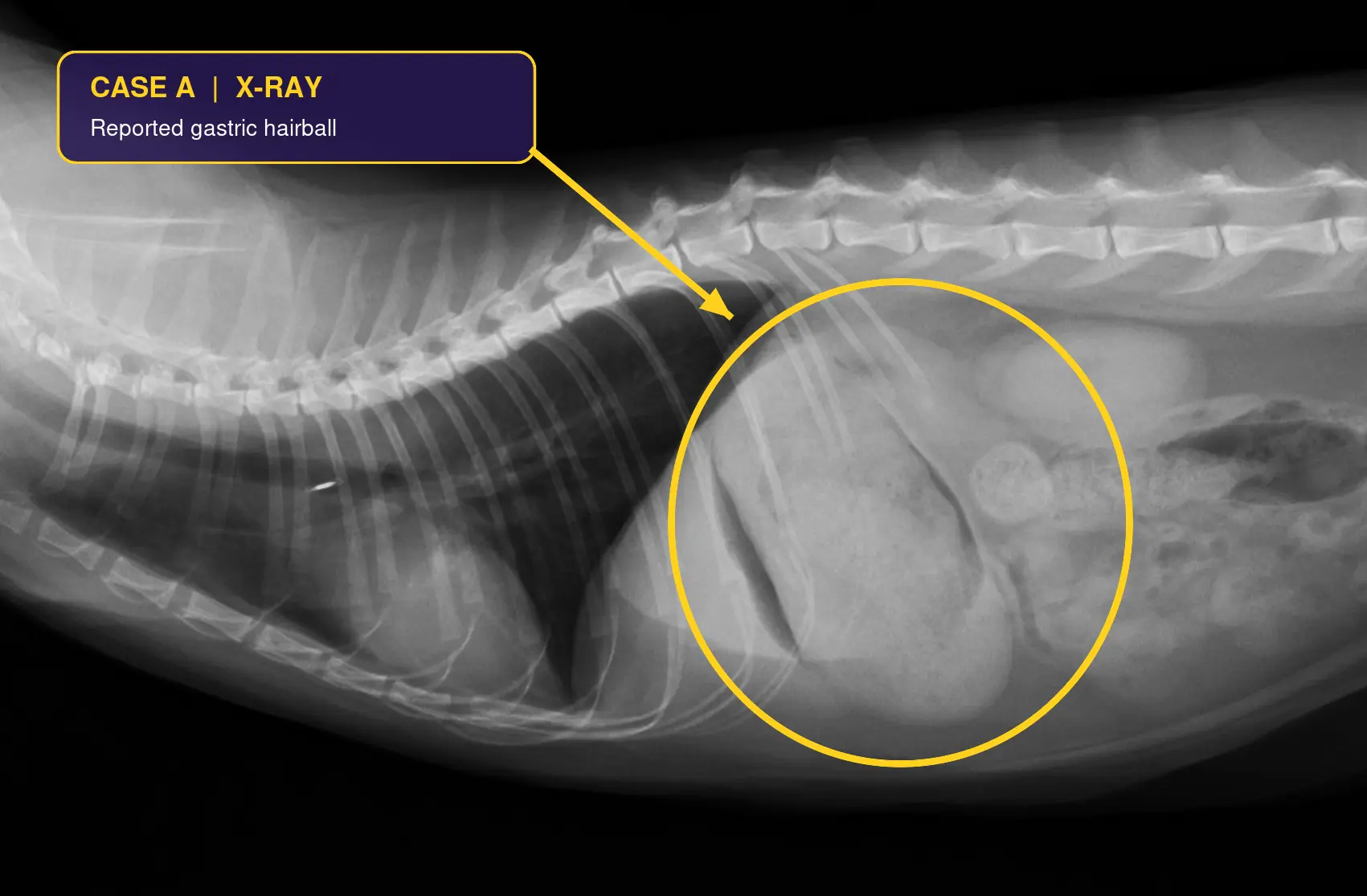
KENDOC Dog & Cat Hospital reported a cat with a giant hairball that had first lodged in the oesophagus. Another clinic moved it back into the stomach as an emergency measure, but the cat continued vomiting after eating.[5]
At KENDOC, the stomach mass was unusually large—described as approximately fist-sized and clearly visible on the radiograph. Endoscopy also found severe oesophageal narrowing after the earlier obstruction and inflammation. The team removed the hairball, supported feeding through a catheter and later performed staged balloon-dilation procedures. The cat eventually returned to eating.[5]
What the X-ray means
The yellow outline shows the area the hospital identified as the gastric hairball. Not every hairball is this obvious on a plain X-ray. Veterinarians interpret the entire image and may use ultrasound, contrast studies or endoscopy when the first image is inconclusive.[5][7]
Case B: Two hairballs removed during emergency abdominal surgery
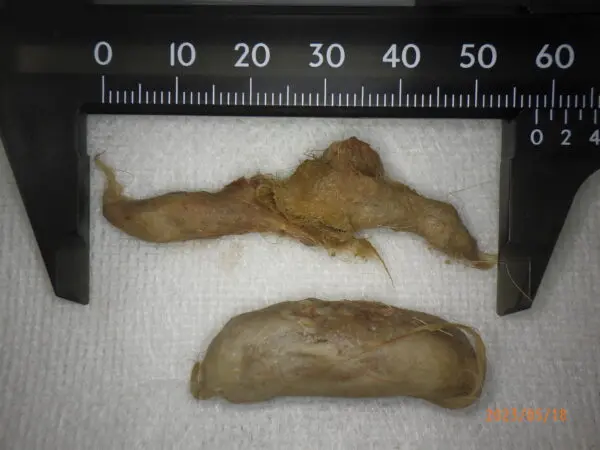
Polan Animal Hospital documented a separate three-year-old long-haired cat that vomited repeatedly for three days and could not keep even water down. The cat arrived severely dehydrated and weak.[6]
Ultrasound suggested foreign material in the small intestine. During emergency surgery, the team found two adjacent masses in the jejunum. Both were large hairballs, and their connected position likely prevented normal passage. After removal, the cat's energy and appetite returned and vomiting stopped.[6]
What made it an emergency?
The warning pattern was more important than the word “hairball”:
- repeated vomiting
- vomiting after drinking water
- dehydration and weakness
- imaging evidence of material lodged in the intestine
The Better Routine: Brush Outside + Support Inside
1. Remove loose fur before it is swallowed
Brush consistently with a tool suited to your cat's coat. Short, calm sessions usually work better than one aggressive grooming session.
2. Support the normal exit route
Once fur has been swallowed, the normal route out is through the stool.[1] Hydration, complete nutrition, appropriate fibre and normal digestive movement all belong in this part of the routine.
3. Watch the pattern
For seven days, note hairball or vomiting episodes, brushing yield, stool consistency, appetite, water intake and unusual grooming. A simple record helps you see change earlier and gives your veterinarian clearer information if the problem continues.
Why Apple Fibre + Pumpkin Matter
This is the part of the PreProZyme hairball story that should not be overlooked.
Apple fibre: supports the stool pathway
Apple-derived fibre contains both soluble and insoluble fibre fractions. Research in adult cats using dried apple pomace confirmed it as a fibrous dietary ingredient and documented effects on faecal dry matter while maintaining acceptable stool scores under the study conditions.[8]
That study did not test PreProZyme or hairball frequency. Its relevance is more specific: apple fibre belongs to the digestive and stool-passage conversation, not merely the ingredient list.**
Pumpkin: food-based fibre support
Pumpkin contributes another food-based source of fibre to the formula. Its role is to help complete the fibre side of the daily digestive routine, alongside adequate water and a complete diet.
Pumpkin and apple fibre do not “melt” hair. Their value is supporting the normal stool route through which most swallowed fur is meant to leave.
The amount, type and complete formula still matter; more fibre is not automatically better. But for a hairball-conscious cat parent, these two ingredients make the formula more relevant than a probiotic-only approach.
Where FURVIN PreProZyme Fits
FURVIN PreProZyme is designed for the inside half of the routine. Every 5 g daily serving combines:
- Apple fibre + pumpkin for food-based fibre support and the normal stool-passage route
- 5.5 Billion CFU probiotics for the intestinal microbial community
- Inulin prebiotic to support the microbial environment
- Five digestive enzymes—protease, cellulase, lipase, bromelain and papain—for food breakdown
That gives hairball-conscious cat parents one consistent formula covering fibre, microbes, prebiotic support and food breakdown—while brushing handles loose fur on the outside.
It is not a petroleum paste, laxative or treatment for obstruction. It is daily digestive-wellness support.
When Should I Contact a Veterinarian?
Seek veterinary advice promptly if your cat has:
- repeated or unproductive retching
- repeated vomiting or coughing
- difficulty keeping food or water down
- poor appetite or weight loss
- marked lethargy or weakness
- abdominal discomfort
- constipation or persistent diarrhoea
Do not use a human laxative or hairball remedy without veterinary direction. Frequent episodes can reflect a skin, grooming, respiratory or gastrointestinal problem that deserves investigation.[1]
Frequently Asked Questions
Are hairballs normal in cats?
An occasional hairball can happen because grooming naturally leads to swallowed hair. A repeated or changing pattern—especially with poor appetite, weight loss, lethargy or unproductive retching—needs closer attention.
Why does my long-haired cat get more hairballs?
Long-haired cats may swallow a greater volume of fur during grooming. Research has also found higher faecal hair quantities and different responses to fibre-containing diets in long-haired versus short-haired cats.[2]
Do apple fibre and pumpkin help with hairballs?
They support the fibre and stool-passage side of the routine—the normal route through which most swallowed hair exits. They do not dissolve an existing hairball, guarantee fewer episodes or treat an obstruction.
Does fibre help with cat hairballs?
Selected fibre combinations have increased faecal hair excretion in feline studies, particularly in long-haired cats.[2] The result cannot be assumed for every fibre, quantity or product.
Can probiotics stop hairballs?
No direct cure claim should be made. Probiotics support the microbial side of digestive wellness; brushing and fibre-supported passage remain important parts of the same routine.
Can I use PreProZyme with hairball food?
They serve different roles and may be used together when appropriate. Introduce products according to their directions, avoid changing several things at once and ask your veterinarian if your cat has an existing condition.
How quickly should I expect a change?
There is no universal timeline. Coat length, shedding, grooming, diet and individual digestive health all affect hairball frequency. Look for a trend in the complete routine rather than an overnight result.
The Bottom Line
Hairballs are not only about the fur you can see.
- Brush outside to reduce loose fur before it is swallowed.
- Support inside with hydration, complete nutrition and a consistent digestive routine.
- Use Apple fibre + pumpkin thoughtfully to support the natural stool route for swallowed fur.
FURVIN PreProZyme brings that inside routine together in one 5 g daily serving.
References / Sources
- The Danger of HairballsCornell University College of Veterinary Medicine
Explains hairball formation, obstruction risk, warning signs and the role of regular brushing.
- Influence of the dietary fibre levels on faecal hair excretion after 14 days in short and long-haired domestic catsVeterinary Medicine and Science (2015)
A controlled study of 21 adult cats examining fibre-containing diets and faecal hair excretion.
- Efficacy of probiotic, prebiotic, synbiotic and postbiotic supplementation on gastrointestinal health in cats: systematic review and meta-analysisJournal of Small Animal Practice (2025)
DOI 10.1111/jsap.13822; PMID 39800337.
- Effects of inulin on fecal microbiota and specific immunity in catsResearch in Veterinary Science (2024)
DOI 10.1016/j.rvsc.2024.105252; PMID 38564887.
- Beware of Hairballs: Oesophageal Stenosis Following Oesophageal Obstruction by a Vomited HairballKENDOC Dog & Cat Hospital
Veterinary case report and source of the Case A radiograph, reproduced with permission.
- A Cat With Intestinal Obstruction Caused by HairballsPolan Animal Hospital
Veterinary case report and source of the Case B specimen photograph, reproduced with permission.
- Surgical Case No. 16: Feline Hairball DiseaseMoriya Animal Hospital
A separate case describing radiography, barium study and surgical removal of an 8 cm intestinal hairball.
- Evaluation of dried apple pomace on digestibility and palatability of diets for catsRevista Brasileira de Zootecnia (2020)
A controlled feeding study in adult cats characterising dried apple pomace as a fibrous dietary component and assessing faecal characteristics; it did not test hairball frequency or PreProZyme.